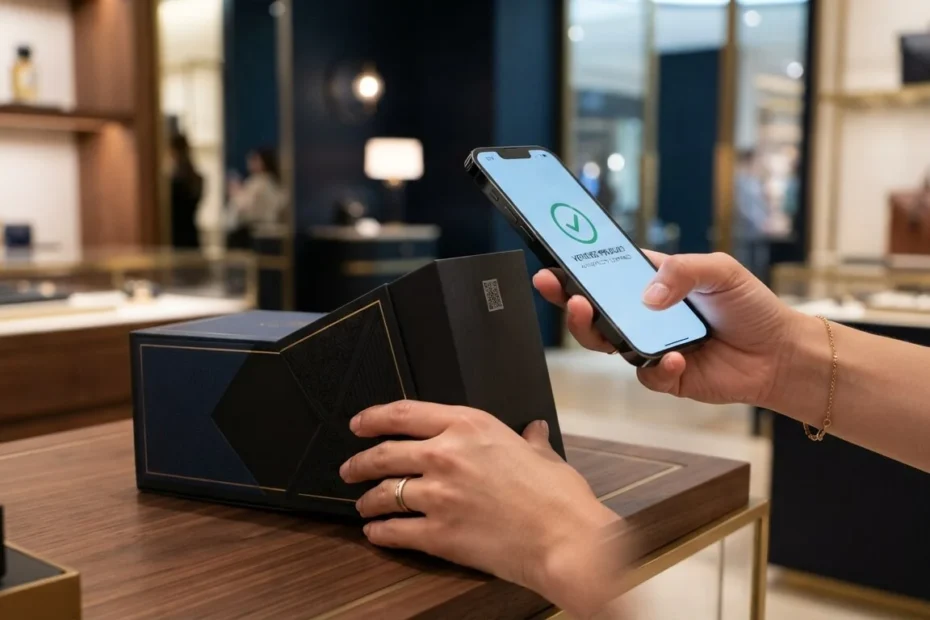
Counterfeiters don’t need your permission to profit from your brand—they only need a product they can copy. A strong brand protection strategy helps businesses prevent counterfeit products, verify genuine products, and identify suspicious activity before fake goods damage customer trust and revenue.
The most effective approach goes beyond a single security label or packaging feature. It combines prevention, product authentication
This guide explains how to build a practical brand protection strategy, which technologies can support it, and the common mistakes that can leave your brand exposed.
What Is a Brand Protection Strategy?
A brand protection strategy is a planned approach to protecting a company’s brand, products, intellectual property, customers, and reputation from threats such as counterfeiting, unauthorized use, infringement, and fake products.
It is not limited to protecting a logo or trademark.
A complete strategy can include:
- Intellectual property protection
- Secure product identification
- Product authentication
- Anti-counterfeit packaging
- QR code verification
- Supply-chain monitoring
- Online marketplace monitoring
- Customer verification
- Suspicious activity detection
- Enforcement and response procedures
The right combination depends on the type of product, distribution network, target market, and level of counterfeit risk.
Why Is Brand Protection Important?
A brand’s reputation is built over time, but counterfeit products can damage customer confidence much faster.
Imagine a customer purchases what appears to be your product. The item turns out to be fake or performs poorly. The customer may not know that the product was counterfeit—they may simply blame your brand.
That creates several risks.
Revenue Loss
Counterfeit products compete with genuine products and can divert potential sales away from legitimate businesses.
Damage to Brand Reputation
Customers associate your name with the quality of the products they purchase. Fake products can weaken that relationship.
Loss of Customer Trust
When customers cannot easily determine whether a product is genuine, they may become less confident in buying from the brand.
Customer Support Problems
Businesses may receive complaints, warranty claims, or product issues involving products they never manufactured or sold.
Increased Business Risk
Counterfeiting can also create additional operational, legal, and distribution challenges.
For this reason, brand protection should be treated as an ongoing business process rather than a one-time security upgrade.
How Counterfeit Products Affect Your Brand
The impact of counterfeiting is not always limited to lost sales.
A counterfeit product can affect several parts of the customer journey:
Fake product → Poor experience → Customer complaint → Brand blamed → Trust decreases
For example, if a customer purchases a counterfeit electronic product and it fails shortly afterward, they may associate that poor experience with the original manufacturer.
This is why businesses need to think beyond “How do I make my product difficult to copy?”
A better question is:
“How can I help customers identify and verify the genuine product?”
That shift is important because modern brand protection is not only about making counterfeiting difficult. It is also about making authentication easier.
How to Build a Brand Protection Strategy
A strong strategy does not necessarily require every available security technology.
Instead, start with your risks and build protection around them.
1. Identify Your Brand’s Biggest Risks
Before choosing a solution, determine where counterfeit products are most likely to appear.
Consider:
- Online marketplaces
- Social media sellers
- Unauthorized retailers
- Wholesale distributors
- Physical stores
- Regional markets
- Unofficial websites
- Parallel distribution channels
2. Protect Your Intellectual Property
Technology should not replace the legal foundation of brand protection.
Businesses should identify and appropriately protect important intellectual-property assets, which may include:
- Brand names
- Logos
- Trademarks
- Product designs
- Packaging designs
- Product names
- Copyrighted materials
- Domains
The specific legal requirements vary by country and business, so companies should seek appropriate professional advice for their situation.
Think of intellectual-property protection as the legal layer of your overall strategy.
Digital authentication and monitoring can then provide additional operational layers.
3. Give Products a Unique Identity
One of the strongest foundations for digital product authentication is giving products a unique identity.
Instead of treating thousands of products as one generic item, businesses can assign individual identifiers to products or batches.
For example:
Product → Unique ID → Digital record → Verification
This creates a connection between the physical product and its digital identity.
When customers or authorized users interact with that identity, the business can use the system to determine whether the product information matches the expected record.
4. Add Product Authentication
Product authentication allows a customer or business to check whether a product can be verified as genuine.
A digital authentication process can work like this:
1. Product receives a unique identifier
↓
2. Identifier is connected to a secure digital record
↓
3. Customer scans or enters the verification information
↓
4. System checks the product identity
↓
5. Verification result is displayed
This gives customers a simple way to interact with the brand’s authentication system.
However, simply putting a QR code on packaging does not automatically make a product counterfeit-proof. The important part is the verification infrastructure behind the code.
5. Make Verification Easy for Customers
Even a technically strong system can fail if customers do not understand how to use it.
The verification process should be:
- Quick
- Mobile-friendly
- Simple
- Clear
- Easy to understand
For example, a customer should not have to navigate through several confusing pages just to determine whether a product can be verified.
A simple experience can be:
Scan → Verify → Understand the result
You can also explain what customers should do if a verification result appears suspicious.
This turns authentication into a practical part of the customer experience rather than another complicated process.
6. Monitor Suspicious Activity
Authentication should not end when the customer sees a verification result.
The data generated through verification can potentially help businesses identify unusual activity.
For example, repeated verification attempts involving the same product identity may deserve further investigation, depending on the system and circumstances.
Monitoring can help businesses understand:
- Which products are being verified
- Where verification activity is occurring
- Whether unusual patterns appear
- Which products may require investigation
- How customers interact with verification
This creates a broader process:
Authenticate → Monitor → Detect → Investigate
That is much stronger than simply placing a security feature on packaging and never checking what happens afterward.
7. Create a Response Process
Finding suspicious activity is only useful if your business knows what to do next.
Create a clear internal process for:
- Investigating suspicious products
- Handling customer reports
- Reviewing unauthorized sellers
- Documenting evidence
- Contacting relevant platforms
- Escalating serious cases
- Taking appropriate legal or commercial action
Your response process should define who is responsible for each step.
This prevents counterfeit incidents from becoming scattered between sales, customer support, legal, and operations teams.
How QR Code Product Verification Helps Prevent Counterfeiting
QR codes can provide a convenient connection between a physical product and a digital verification experience.
A customer can scan a QR code using a smartphone and access a verification page.
Depending on the system, the verification experience can connect the product to information such as:
- Product identity
- Verification status
- Warranty information
- Product details
- Customer registration
- Suspicious verification activity
For businesses, this creates an opportunity to make authentication part of the normal customer journey.
But there is an important distinction:
A QR code is not the security system by itself.
A copied QR code can potentially be placed on another product. Therefore, the system behind the QR code needs to manage unique product identities and verification rules appropriately.
This is where a dedicated product verification platform can become useful.
Physical Anti-Counterfeit Features vs Digital Verification
Businesses often have to decide whether to use physical security features, digital authentication, or both.
| Method | Main Purpose | Customer Verification | Digital Monitoring |
|---|---|---|---|
| Hologram | Visual security | Limited | No |
| Security label | Physical identification | Limited | No |
| Serial number | Product identification | Possible | Depends on system |
| QR verification | Digital authentication | Yes | Yes |
| Digital warranty | Authentication + after-sales | Yes | Yes |
| Combined approach | Multiple protection layers | Yes | Yes |
There is no universal solution for every product.
For some products, physical security features may remain useful. For others, digital authentication may provide additional visibility and customer engagement.
In many cases, layered protection can be more practical than relying on one feature.
Common Brand Protection Mistakes
Relying Only on Packaging
A sophisticated package may make copying more difficult, but it does not necessarily give customers a reliable way to verify the product.
Waiting Until Counterfeits Become a Major Problem
A proactive strategy gives businesses more opportunity to identify risks before counterfeit activity becomes difficult to manage.
Making Authentication Complicated
If customers need several steps to verify a product, they may simply ignore the process.
Assuming a QR Code Is Enough
A QR code without a properly designed verification system is not a complete anti-counterfeit solution.
Ignoring Online Channels
Counterfeit products can appear on marketplaces, social media, and unofficial websites. Brand protection should consider both physical and digital channels.
Never Reviewing Verification Data
A verification system can generate useful signals. Ignoring them means missing an opportunity to identify unusual activity.
Treating Brand Protection as a One-Time Project
Counterfeiters, technologies, marketplaces, and customer behavior change. Your protection strategy should evolve as those risks change.
A Simple Brand Protection Framework
If you are starting from zero, follow this simple framework:
1. Identify
Understand your products, customers, distribution channels, and counterfeit risks.
2. Protect
Protect important intellectual-property assets and strengthen physical product security where appropriate.
3. Authenticate
Give products a reliable and convenient way to establish their identity.
4. Monitor
Track verification activity and watch for suspicious patterns.
5. Respond
Create a process for handling counterfeit reports and unauthorized activity.
6. Improve
Regularly review what is working and strengthen weak areas.
This makes brand protection an ongoing cycle rather than a one-time implementation.
How AuthX Can Support Your Brand Protection Strategy
A digital product verification platform can become one layer of a wider brand protection strategy.
AuthX provides solutions focused on product verification, QR authentication, counterfeit prevention, digital warranties, and customer engagement.
A simplified customer journey can look like:
Physical Product
↓
Unique Product Identity
↓
QR Authentication
↓
Customer Verification
↓
Monitoring
↓
Warranty / Customer Engagement
The exact implementation depends on your products, distribution model, customer journey, and business requirements.
Instead of treating product verification as a standalone feature, businesses can integrate it into a wider strategy designed to protect the product and strengthen customer confidence.
FAQs
Anti-counterfeiting specifically targets fake products. Brand protection is broader — it also covers unauthorized resellers, trademark infringement, and misuse of brand assets like logos and marketing content.
Costs vary by product volume and complexity. Options range from low-cost QR-based verification for small brands to enterprise systems combining serialization, monitoring, and legal enforcement.
Yes. Many verification tools offer scalable pricing, and basic steps like trademark registration and marketplace monitoring provide meaningful protection without a large budget.
Pharmaceuticals, electronics, luxury goods, cosmetics, and food and beverage face the highest counterfeit risk due to high resale value and, in some cases, direct safety implications.
Conclusion
A brand protection strategy that works isn’t built from one tactic. It’s authentication, supply chain control, marketplace monitoring, and enforcement operating together, consistently, over time.
Start by assessing where your brand is most exposed. Build outward layer by layer, and revisit the plan regularly as counterfeiters adapt to whatever defenses you put in place.Protect your brand today — get a free AuthX demo.